Exploring the influence of urban land use and morphology on diurnal heat variation: Insights from Travis, Texas
Huan Chen†, Chenxi Du†, Ting Han†, Yifei Jiang, Zixuan Wang, Hongjun Su, Xinchang Zhang, Yiping Chen*
Urban Informatics, 2026
Quantifying the heat island effect by integrating high-temperature hazards with urban land use, morphology, and environmental components is critical to understanding the comprehensive impacts of urban thermal environments.
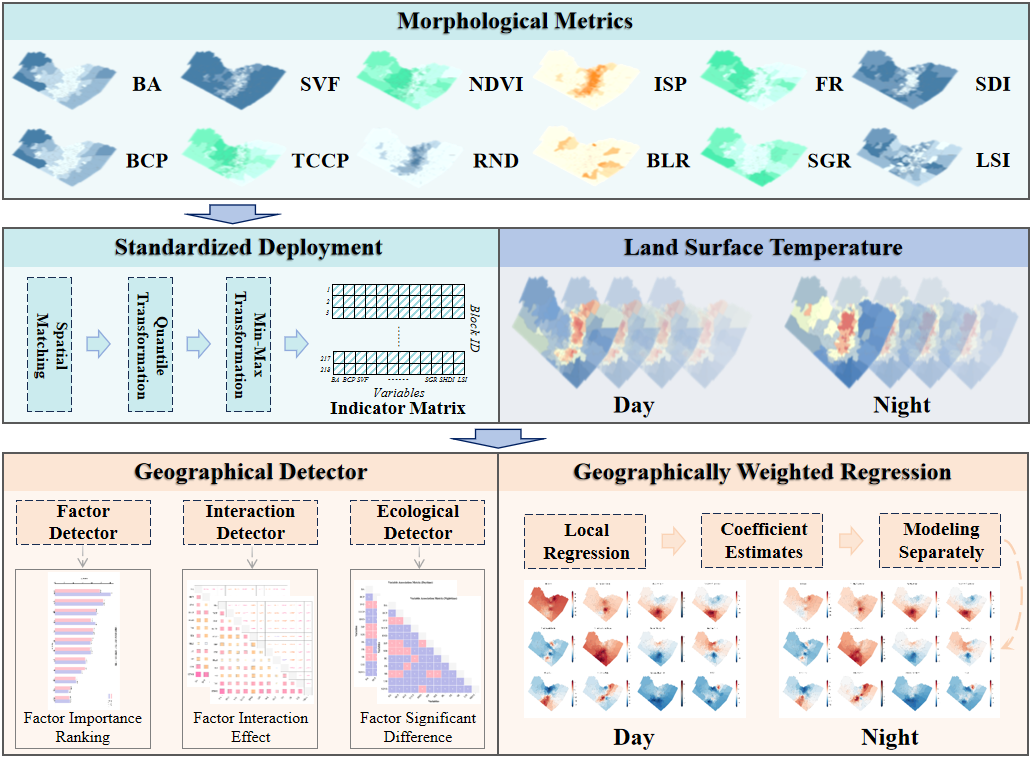
This study proposes an interpretable and scalable framework to examine the diurnal variation of land surface temperature (LST) in response to multi-dimensional urban morphological features.
Using Travis, Texas, as a representative case, we compile a comprehen-sive framework combining building patterns, land cover classifications, and environmental indicators.
A total of 12 morphological metrics across six thematic dimensions are extracted at the urban block scale.
We employ spatial statistical techniques, such as the Geographical Detector and Geographically Weighted Regression (GWR), to identify key drivers, nonlinear interactions, and spatial heterogeneity of LST across day and night periods.
The results reveal strong spatial variability and diurnal asymmetry in thermal responses.
Hard infrastructure factors such as impervious surface percentage and road density are positively associated with LST, while vegetation indices and landscape complexity exhibit significant cooling effects, particu-larly at night.
Interactive effects among indicators display complex synergistic and threshold behaviors, indicating that com-bined urban features may amplify or offset thermal risks depending on spatial context.
GWR further confirms localized variations in effect magnitude and direction, reinforcing the need for site-specific mitigation strategies.
This study highlights the importance of integrating interpretable spatial statistical analysis with geospatial diagnostics to disentangle the multifactorial mechanisms underlying urban heat exposure.
The proposed methodology provides both scientific insights and actionable guidance for data-informed, climate-resilient urban planning.